Ask Your Questions
Future of Nigeria’s Packaging Industry: Expert Insights from FLEXOEDGE 2026
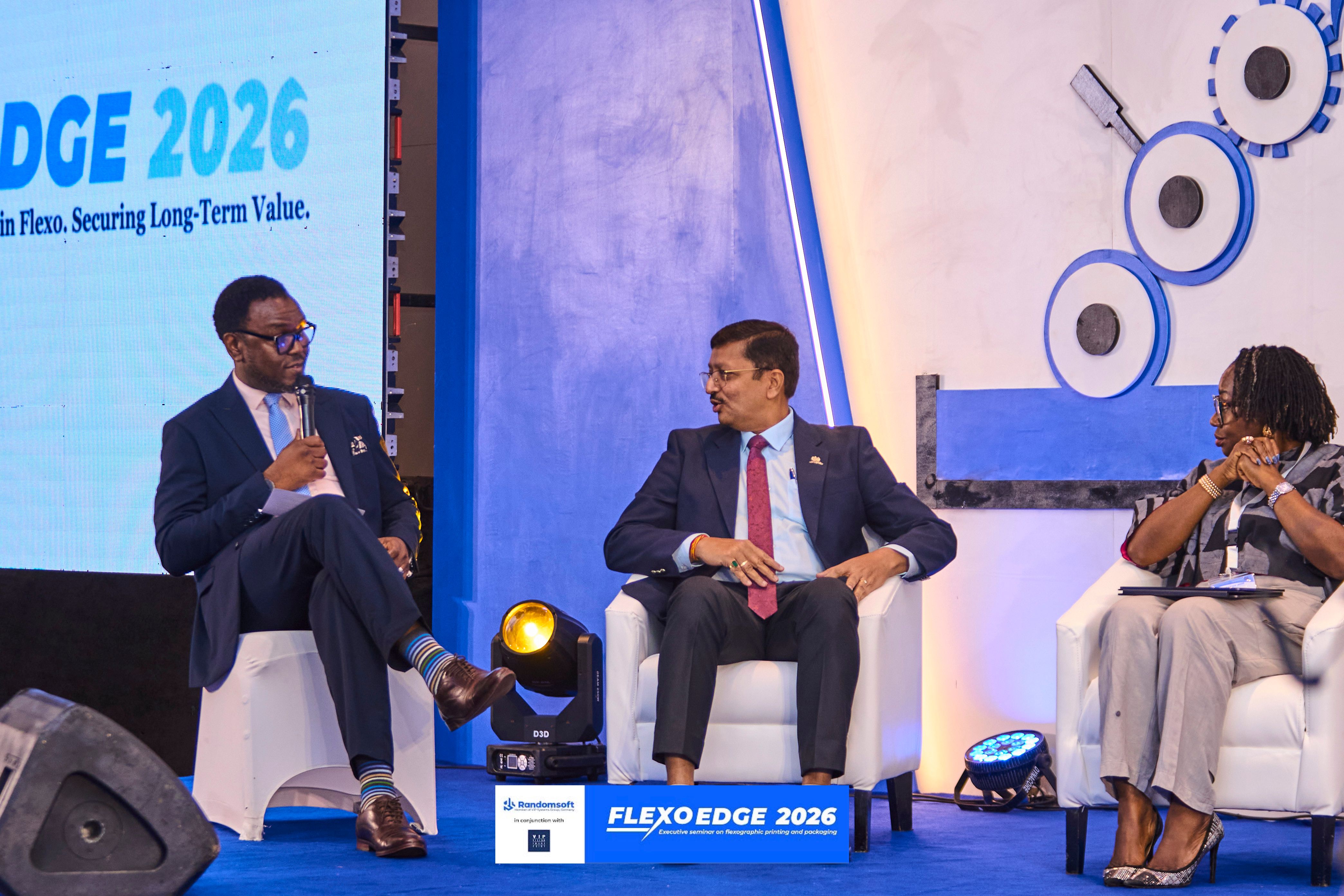
The Nigeria packaging industry is currently undergoing a radical transformation. Driven by shifting consumer behaviors, rising operational costs, and a global push toward environmental responsibility, the sector has moved beyond traditional manufacturing. Today, packaging is recognized as a critical pillar of brand strategy and supply chain efficiency. These transformative trends were the focal point of the FLEXOEDGE 2026 Panel Session, a landmark event hosted by Random Soft Printing in collaboration with VIP Systems (Germany).
The summit brought together an elite group of thought leaders: Ajai Musaddi (Group Managing Director, Sona Group of Industries), Titilayo Oshodi (Special Adviser to the Lagos State Governor on Climate Change and Circular Economy), Princess Layo Bakare-Okeowo (MD/CEO, FAE Limited), and Godson Nkeokelonye (CEO, Excite Panacea Limited). Their collective insights provide a roadmap for navigating the complexities of modern manufacturing in West Africa.
Packaging as a Strategic Investment for Business Growth
A central theme of the discussion was the paradigm shift from viewing packaging as an overhead cost to treating it as a high-value asset. Ajai Musaddi emphasized that in a high-inflation environment, smart packaging solutions are essential for protecting margins and enhancing market share.
Although each speaker approached the conversation from a different perspective, they all reinforced one important message: businesses that continue to treat packaging as an afterthought risk falling behind in an increasingly competitive marketplace.
Packaging Is No Longer a Cost, It Is a Strategic Investment
Opening the discussion, Ajai Musaddi, Group Managing Director of Sona Group of Industries, challenged manufacturers to rethink how they view packaging. For many years, businesses considered packaging an operational expense, but Musaddi argued that modern packaging has become a strategic investment capable of delivering measurable business value.
According to him, investments in advanced packaging technologies improve production efficiency, reduce material waste, optimize manufacturing processes and create long-term cost savings. More importantly, they strengthen competitiveness by improving product quality and supporting stronger customer experiences.
Musaddi explained that businesses should no longer ask only how much packaging costs, but rather how much value it creates across the production process, supply chain and marketplace.
That value extends beyond the factory floor. Smarter packaging protects products more effectively, improves operational efficiency, reduces waste, supports sustainability goals and enhances brand perception. In today's marketplace, packaging has become an investment that generates returns throughout the product lifecycle.
Your Packaging Introduces Your Brand Before Your Product Does
Building on the conversation, Princess Layo Bakare-Okeowo, Managing Director and Chief Executive Officer of FAE Limited, shifted attention from manufacturing to consumer behaviour.
She observed that consumers often begin forming opinions about a product long before they experience what is inside the package. Whether it is a flexible pouch, folding carton, label or simple envelope, packaging immediately communicates professionalism, quality and credibility.
As retail shelves become increasingly competitive and online shopping continues to grow, businesses can no longer rely solely on advertising to differentiate themselves. Packaging has become one of the most powerful marketing tools available because it continues communicating the brand every time consumers encounter the product.
Packaging Has Become the Fifth “P” of Marketing
Expanding on the relationship between branding and business performance, Godson Nkeokelonye, Founder and Chief Executive Officer of Excite Panacea Limited, challenged one of marketing's oldest principles.
For decades, marketers have relied on the traditional four Ps: Product, Price, Place, and Promotion. However, Nkeokelonye argued that today's marketplace demands a fifth P: Packaging.
According to him, packaging has become a strategic marketing asset that communicates quality before customers ever interact with the product itself. Businesses that overlook its importance risk losing valuable opportunities to influence purchasing decisions.
One of his most memorable observations centred on what he described as the "six-second decision process." He explained that consumers often make purchasing decisions within moments of seeing a product, based largely on its look and feel. Before customers compare prices or examine product features, packaging has already begun communicating the brand's quality, credibility and value.
In that sense, packaging functions as a silent salesperson, working continuously to attract attention, build trust and encourage purchase without saying a single word.
Sustainability Is No Longer Optional
Speaking from a policy and sustainability perspective, Titilayo Oshodi, Special Adviser to the Lagos State Governor on Climate Change and Circular Economy, emphasised that sustainability should no longer be viewed as a compliance requirement but as a business opportunity.
She encouraged manufacturers to rethink packaging design by asking practical questions: Can less material be used? Can packaging be recycled or reused? Can waste be reduced across the supply chain? Can packaging contribute to greater efficiency while lowering environmental impact?
She further encouraged manufacturers to embrace emerging innovations, including chemical and biological recycling technologies, which can improve the recyclability of packaging materials and support the transition towards a circular economy.
Rather than treating sustainability as a future ambition, Oshodi argued that businesses should integrate it into today's investment decisions to ensure long-term resilience and global relevance.
Building a Circular Economy Starts with Smarter Packaging
Expanding on the sustainability conversation, Titilayo Oshodi explained that packaging should be designed with its entire lifecycle in mind. Rather than following the traditional "produce, use and dispose" model, manufacturers should adopt circular economy principles that keep materials in use for as long as possible through reuse, recycling and recovery.
She noted that Nigeria has significant opportunities to build a thriving circular economy, but businesses must begin viewing waste as a valuable resource rather than an inevitable by-product of production. Oshodi also stressed that Nigeria already has enormous untapped opportunities. According to her, many of these opportunities remain unrealised because the country does not adequately collect, analyse or use data to inform decisions.
"There are many opportunities in Nigeria," she observed, explaining that countries such as China have excelled because they recognise opportunities early, invest in them and rely on data to drive industrial development. She encouraged businesses to adopt the same mindset by documenting performance, measuring impact and making decisions based on evidence rather than assumptions.
Reliable data, she explained, is becoming increasingly important for sustainability reporting, attracting investment, measuring environmental performance and demonstrating business value. Manufacturers that embrace data-driven decision-making will be better positioned to compete globally and access emerging opportunities, including green finance.
Nigeria's Manufacturing Sector Still Faces Significant Challenges
While the panel remained optimistic about the industry's future, Ajai Musaddi provided a realistic assessment of the obstacles confronting manufacturers.
Drawing on decades of manufacturing experience, he identified several structural challenges that continue to increase production costs and reduce competitiveness. These include rising energy costs driven by dependence on diesel-powered electricity, delays at Nigerian ports, inadequate transport infrastructure, heavy reliance on imported raw materials, foreign exchange volatility, high logistics costs and limited access to affordable financing.
Musaddi explained that these challenges place enormous pressure on manufacturers, making it more expensive to produce locally while reducing their ability to compete with imported products.
Despite these realities, he commended Nigerian manufacturers for their resilience, noting that many businesses continue investing in modern equipment, improving production quality and expanding local manufacturing capacity.
However, he emphasised that resilience alone cannot sustain long-term industrial growth. To unlock the full potential of Nigeria's manufacturing sector, government and industry must work together to improve infrastructure, strengthen logistics, expand access to affordable financing and implement policies that encourage local production.
Financing Growth Requires Stronger Collaboration
The discussion also highlighted the importance of financing in driving industrial development.
Princess Layo Bakare-Okeowo, Managing Director and Chief Executive Officer of FAE Limited, called on the government to create a more enabling environment for manufacturers by strengthening support through Development Finance Institutions (DFIs). She urged policymakers to move beyond denial about the challenges facing the manufacturing sector, make affordable financing more accessible and give manufacturers the flexibility to make business decisions that best suit their operations and growth.
The panel also explored the growing importance of sustainable finance, noting that businesses with credible environmental and ESG practices are increasingly well positioned to access investment opportunities designed to support responsible manufacturing.
Innovation Must Strengthen Both Industry and Employment
Another important theme throughout the discussion was the relationship between technological innovation and employment.
Panelists agreed that automation, digital technologies and smarter manufacturing systems are essential for improving productivity. At the same time, they emphasised that innovation should not come at the expense of people.
Manufacturing remains one of Nigeria's most important employers, supporting thousands of jobs across production, logistics, warehousing and distribution. Investments in technology should therefore be accompanied by investments in workforce development, skills training and capacity building to ensure that industrial progress creates new opportunities rather than limiting them.
The panel agreed that balancing innovation with inclusive economic growth will be essential to the long-term success of Nigeria's manufacturing sector.
Looking Ahead
FLEXOEDGE 2026 demonstrated that the future of Nigeria's packaging industry will be shaped by more than advances in printing technology. It will depend on how businesses respond to changing consumer expectations, sustainability demands and an increasingly competitive global marketplace.
The insights shared by Ajai Musaddi, Titilayo Oshodi, Princess Layo Bakare-Okeowo and Godson Nkeokelonye reflected both the challenges and the opportunities confronting the industry. While each speaker approached the conversation from a different perspective, they all pointed toward the same conclusion: packaging has become a strategic driver of business performance.
It protects products, strengthens brands, improves logistics, supports sustainability and creates meaningful competitive advantage. Businesses that recognise this shift and invest accordingly will be better positioned to succeed in the years ahead.
As the industry continues to evolve, one message from the panel remains clear: the future belongs to businesses that invest smartly, embrace sustainability, harness innovation and recognise packaging not merely as a protective layer, but as a catalyst for business growth and national industrial development.
Certified to Deliver Excellent & Reliable Service
“Randomsoft Limited has been instrumental in keeping our Kodak CTP machine running smoothly. Their technical expertise and prompt response have saved us countless hours of downtime.”
- Production Manager, Lagos State Printing Corporation
“Since partnering with Randomsoft, we’ve experienced top-tier service support. Their engineers are knowledgeable, reliable, and truly understand the printing industry.”
- CEO, PrintBox Nig. Ltd
“We rely on Randomsoft for all our equipment maintenance and consumables. Their relationship with global dealers ensures we get original parts quickly and at competitive rates.”
- Head of Operations, Printing and Packaging LTD